TL;DR
Most corporate events fail because companies focus on logistics, entertainment, and attendance numbers instead of lead generation and business outcomes. The solution is a structured event marketing strategy that aligns audience targeting, engagement activities, lead capture systems, and post-event nurturing to drive measurable ROI.
The Hidden Problem with Most Corporate Events
Corporate events continue to be one of the most powerful marketing channels available to businesses. Industry reports estimate that the global events industry is expected to surpass $1.6 trillion in value within the coming years, highlighting the growing importance of live experiences in business growth.
Yet despite increasing investments, many organizations walk away from events with the same frustrating conclusion:
“The event was successful, but we didn’t generate enough business.”
The venue was impressive.
The speakers were engaging.
The audience seemed happy.
But the sales pipeline remains unchanged.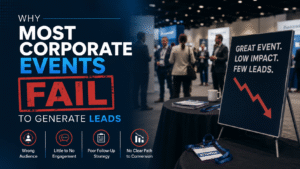
This happens because most organizations measure event success using vanity metrics such as:
- Number of attendees
- Social media impressions
- Event registrations
- Event photos and coverage
- Audience applause
While these metrics matter, they do not directly contribute to revenue.
Successful brands understand that every corporate event should support a larger business objective.
Why Lead Generation Should Be the Primary Event KPI
A corporate event is not simply a gathering.
It is a business growth opportunity.
Whether you’re hosting:
- Conferences
- Product launches
- Leadership summits
- Trade exhibitions
- Networking events
- Dealer meets
- Corporate celebrations
The ultimate goal should be generating meaningful business relationships and qualified opportunities.
When events are designed around lead generation, they become:
| Traditional Event | Lead-Focused Event |
|---|---|
| Focus on attendance | Focus on qualified prospects |
| Measures registrations | Measures conversions |
| One-day experience | Long-term sales pipeline |
| Entertainment-driven | Business outcome-driven |
| Short-term impact | Sustainable revenue growth |
7 Reasons Corporate Events Fail to Generate Leads
1. No Clear Business Objective
One of the biggest mistakes companies make is organizing events without defining success beforehand.
Questions that should be answered before planning begins:
- How many qualified leads are needed?
- What industries should attend?
- What actions should attendees take?
- What revenue target should the event influence?
Without clear objectives, every decision becomes disconnected from business outcomes.
2. Wrong Audience Targeting
An event filled with attendees doesn’t necessarily mean it’s filled with buyers.
Many organizations spend heavily on promotion but fail to attract decision-makers.
For example:
A software company targeting enterprise clients may attract students, freelancers, and junior employees instead of CEOs, CTOs, and procurement heads.
The result?
High attendance.
Low conversions.
The solution is precise audience segmentation before promotion begins.
3. Focusing on Attendance Instead of Engagement
Attendance is not engagement.
An attendee who checks in and leaves after lunch contributes little business value.
Instead, brands should create opportunities for:
- Product demonstrations
- Interactive sessions
- Networking discussions
- Live consultations
- Expert Q&A sessions
- Personalized experiences
The longer attendees engage, the higher the conversion potential.
4. Lack of Data Collection Systems
Many events still rely on outdated registration methods.
Companies often miss critical information such as:
- Industry
- Job title
- Purchase intent
- Budget range
- Business challenges
Without this data, follow-up becomes generic and ineffective.
Modern events should integrate:
- QR-based registrations
- Event apps
- Digital surveys
- Interactive polls
- Lead scoring systems
5. Weak Event Experience
Today’s attendees expect more than presentations.
They expect experiences.
Experiential marketing has transformed how brands connect with audiences by creating memorable interactions that drive stronger engagement and brand recall.
Poor experiences often include:
- Long waiting times
- Generic presentations
- Lack of interaction
- Confusing schedules
- Technical issues
A memorable experience increases trust and purchase intent.
6. No Post-Event Follow-Up Strategy
This is where most leads are lost.
Many companies spend months planning an event and then disappear once it ends.
Research consistently shows that purchasing decisions often happen after multiple interactions.
A strong follow-up process includes:
- Thank-you emails
- Personalized outreach
- Event recap content
- Consultation invitations
- Sales calls
- Retargeting campaigns
The event should be viewed as the beginning of the customer journey, not the end.
7. No ROI Tracking Framework
If you cannot measure results, you cannot improve them.
Every corporate event should track:
- Cost per lead
- Lead-to-opportunity ratio
- Opportunity-to-sale ratio
- Revenue generated
- Customer acquisition cost
- Event ROI
Without these metrics, future event investments become difficult to justify.
The Corporate Event Lead Generation Framework
Stage 1: Pre-Event Strategy
Before launching an event:
✔ Define revenue goals
✔ Create attendee personas
✔ Build landing pages
✔ Launch targeted campaigns
✔ Create lead magnets
✔ Schedule appointments before the event
✔ Promote speakers strategically
Stage 2: During the Event
Focus on engagement.
Implement:
- QR lead capture
- Live polls
- Networking lounges
- Product showcases
- Interactive experiences
- Personalized consultations
- Gamification activities
The objective is simple:
Capture meaningful conversations.
Not just attendance.
Stage 3: Post-Event Conversion
Within 24–72 hours:
- Send thank-you communications
- Share presentations and resources
- Segment leads
- Prioritize high-intent prospects
- Schedule sales meetings
- Launch retargeting campaigns
This is where actual revenue is generated.
Metrics Every Corporate Event Should Track
| KPI | Why It Matters |
|---|---|
| Registrations | Measures interest |
| Attendance Rate | Measures effectiveness |
| Engagement Rate | Measures participation |
| Qualified Leads | Measures business value |
| Meetings Booked | Measures intent |
| Opportunities Created | Measures pipeline impact |
| Revenue Influenced | Measures ROI |
| Customer Acquisition Cost | Measures profitability |
Case Study Example
Imagine two companies each spending ₹15 lakh on a corporate conference.
Company A
- 1,000 attendees
- No lead capture
- No follow-up
- No measurable ROI
Company B
- 600 targeted attendees
- QR lead capture
- Personalized networking
- Automated nurturing
- Sales meetings scheduled
Result:
Company B generates significantly more revenue despite lower attendance because the event was designed around conversions rather than visibility.
How Professional Event Management Companies Deliver Better Results
Modern event partners do much more than organize venues and manage logistics.
The best event management companies help businesses:
- Define event objectives
- Design audience journeys
- Create engagement experiences
- Build lead generation systems
- Track event ROI
- Execute post-event marketing
This strategic approach transforms events into measurable growth channels instead of one-time experiences.
For businesses looking to maximize event ROI, working with experienced event professionals can significantly improve planning, execution, attendee engagement, and conversion outcomes
6. FAQ SECTION
Why do most corporate events fail to generate leads?
Most corporate events fail because companies focus on attendance, branding, and entertainment rather than lead capture and conversion strategies.
Many businesses invest heavily in venues, speakers, and event production but fail to create a structured process for identifying prospects, collecting attendee data, and nurturing relationships after the event. Without these elements, even a well-attended event may generate little business impact.
How can a corporate event generate more qualified leads?
A corporate event generates more qualified leads when it attracts the right audience and incorporates engagement-driven lead capture systems.
Effective tactics include:
- Targeted attendee recruitment
- Pre-event appointment booking
- QR code lead capture
- Interactive product demonstrations
- Networking sessions
- Lead scoring systems
- Personalized follow-up campaigns
The focus should be on quality conversations rather than simply increasing attendance numbers.
What metrics should be used to measure corporate event success?
The most important corporate event metrics include:
- Registration numbers
- Attendance rate
- Engagement rate
- Qualified leads generated
- Meetings booked
- Sales opportunities created
- Revenue influenced
- Event ROI
- Cost per lead
Tracking these KPIs helps businesses understand the true financial impact of their events.
What is a good ROI for a corporate event?
A successful corporate event should generate measurable business outcomes that exceed the total event investment.
While ROI varies by industry, many organizations aim for:
- 3X to 5X return on event spend
- Increased sales pipeline value
- New partnership opportunities
- Higher customer retention
- Enhanced brand authority
The exact benchmark depends on business objectives and event type.
How important is post-event follow-up?
Post-event follow-up is often the most critical phase of event marketing.
Many attendees require multiple interactions before making a purchasing decision. Companies that follow up within 24–72 hours with personalized communications, meeting invitations, and valuable resources typically see significantly higher conversion rates than those that do not.
What role does experiential marketing play in lead generation?
Experiential marketing creates memorable brand interactions that increase engagement, trust, and purchase intent.
When attendees actively participate in experiences rather than passively consume information, they are more likely to remember the brand and continue the conversation after the event.
Should businesses hire a professional event management company?
For organizations seeking measurable ROI, working with an experienced event management company can provide substantial advantages.
Professional event teams help with:
- Audience targeting
- Event strategy
- Experience design
- Lead capture implementation
- Event technology integration
- ROI tracking
- Post-event engagement
BLOG BY: BUZZ ENTERTAINMENT
Follow us on Linkedin – Buzz Entertainment Media