TL;DR
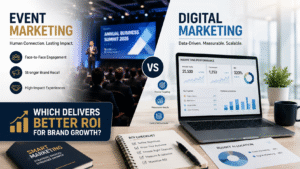
Event marketing and digital marketing both support brand growth, but they deliver ROI in different ways.
Event marketing works best when a brand wants trust, direct interaction, premium positioning, networking, product experience and relationship-building.
Digital marketing works best when a brand wants visibility, lead generation, retargeting, measurable traffic, content reach and scalable conversions.
The strongest ROI usually comes when both work together. Events create high-impact brand experiences. Digital marketing amplifies those experiences before, during and after the event.
For most modern brands, the real question is not “event marketing vs digital marketing.” The better question is: how can both channels work together to create measurable growth?
Why Brands Compare Event Marketing and Digital Marketing
Marketing budgets are under more pressure than ever. Founders and marketing teams are expected to justify every rupee spent.
Before approving a campaign, leadership wants to know:
- Will this generate leads?
- Will it improve brand recall?
- Will it increase sales conversations?
- Will it create measurable ROI?
- Will it build long-term brand value?
- Will it reach the right audience?
This is why many businesses compare event marketing vs digital marketing.
Event marketing feels powerful because it creates real-world interaction. Digital marketing feels practical because it is measurable and scalable. Both have value, but they serve different stages of brand growth.
A brand that only runs digital campaigns may get reach but struggle with trust. A brand that only hosts events may create strong experiences but miss scalable visibility.
The smartest brands do not treat these channels as competitors. They use them as connected growth engines.
What Is Event Marketing?
Event marketing means promoting a brand, product, service or business objective through live, virtual or hybrid experiences.
It includes:
- Corporate events
- Product launches
- Brand activations
- Trade shows
- Conferences
- Dealer meets
- Exhibitions
- Networking events
- Customer experience events
- Workshops
- Webinars
- Sponsored events
The biggest strength of event marketing is human interaction.
People can see the brand, meet the team, experience the product, ask questions and build trust. This makes event marketing especially useful for businesses where relationships matter.
For example, a B2B company launching a premium service may struggle to explain its value through ads alone. A well-planned event can bring decision-makers into one room, demonstrate expertise and start meaningful conversations.
What Is Digital Marketing?
Digital marketing means promoting a brand through online channels.
It includes:
- SEO
- Social media marketing
- Paid ads
- Website development
- Landing pages
- Email marketing
- Content marketing
- Influencer campaigns
- Video marketing
- Performance marketing
- Retargeting
- Analytics and conversion tracking
The biggest strength of digital marketing is scale.
A brand can reach thousands of people without hosting a physical event. It can track clicks, traffic, leads, conversions and campaign performance.
Digital marketing also works continuously. A blog can bring traffic for months. SEO can generate long-term visibility. Paid ads can create quick reach. Social media can build regular engagement.
For brands that want consistent discovery, digital marketing is essential.
Event Marketing vs Digital Marketing: Core Differences
| Factor | Event Marketing | Digital Marketing |
|---|---|---|
| Main Strength | Human connection | Scalable reach |
| Best For | Trust, networking, experience | Visibility, leads, traffic |
| Cost Type | Usually higher upfront cost | Flexible and scalable |
| Measurement | Needs structured tracking | Easier to track digitally |
| Audience Depth | High engagement | Wide reach |
| Speed | Event-specific impact | Continuous impact |
| Content Value | Strong content capture opportunity | Strong distribution channel |
| ROI Timeline | Medium to long-term | Short to long-term |
| Ideal Use | Premium brand experiences | Always-on growth |
Both channels are valuable, but they should not be measured with the same expectations.
Event marketing creates deeper engagement. Digital marketing creates broader visibility.
ROI Comparison: Which Performs Better?
1. Brand Awareness
Digital marketing usually wins in reach.
Through SEO, social media, paid ads and content, a brand can reach a large audience repeatedly. This is useful for businesses that want visibility across cities, industries or customer segments.
Event marketing creates smaller but deeper awareness. The audience may be limited, but the brand impression is stronger because people experience the brand directly.
Winner:
Digital marketing for reach.
Event marketing for depth.
2. Lead Generation
Digital marketing often produces more measurable leads.
Landing pages, paid ads, SEO and social campaigns can be tracked clearly. Brands can measure cost per lead, conversion rate and source quality.
Event marketing can also generate strong leads, especially in B2B. However, it needs proper systems such as RSVP tracking, QR check-ins, lead forms, CRM tagging and post-event follow-up.
Without tracking, event leads are often lost.
Winner:
Digital marketing for scalable lead generation.
Event marketing for high-intent relationship-based leads.
3. Trust Building
Event marketing has a clear advantage in trust.
When people meet a brand in person, attend a session, interact with the team or experience the product, trust builds faster. This is difficult to achieve through ads alone.
Digital marketing builds trust through consistency. Blogs, testimonials, reviews, videos, case studies and social proof support credibility over time.
Winner:
Event marketing for direct trust.
Digital marketing for long-term authority.
4. Cost Efficiency
Digital marketing is more flexible.
A brand can start with a small budget and scale based on performance. Campaigns can be paused, edited and optimized.
Event marketing usually requires a larger upfront budget. Venue, production, food, branding, speakers, logistics and manpower can make events expensive.
However, a well-executed event can create high-value business opportunities that digital ads may not achieve alone.
Winner:
Digital marketing for budget flexibility.
Event marketing for premium relationship value.
5. Measurability
Digital marketing is easier to measure.
Brands can track:
- Website visits
- Keyword rankings
- Clicks
- Leads
- Cost per lead
- Conversion rate
- Ad spend
- Engagement
- Retargeting performance
Event marketing can also be measured, but only if planned properly.
Event KPIs include:
- Registrations
- Attendance rate
- Qualified leads
- Meetings booked
- Booth visits
- Session engagement
- Social media mentions
- Post-event enquiries
- Sales pipeline influenced
Winner:
Digital marketing for simple tracking.
Event marketing can perform well if tracking is built from the start.
6. Long-Term Growth
Digital marketing creates long-term assets.
SEO blogs, landing pages, videos, social media content and email lists continue to support growth after the campaign ends.
Event marketing can also create long-term value when content is captured properly. One event can become multiple social posts, videos, blogs, case studies, testimonials and PR stories.
Winner:
Digital marketing for continuous visibility.
Event marketing becomes powerful when converted into content.
When Event Marketing Delivers Better ROI
Event marketing is a better choice when the goal is relationship-heavy.
It works especially well for:
- Product launches
- Premium brand positioning
- B2B networking
- Investor events
- Dealer meets
- Customer experience campaigns
- Brand activations
- Corporate reputation building
- Community engagement
- Employee engagement
Event marketing delivers better ROI when the audience is specific and valuable.
For example, if a company wants to engage 100 high-value decision-makers, a focused event may deliver stronger results than a broad ad campaign. The event allows direct conversation, live demonstration and trust-building.
Event marketing works best when:
- The audience needs education
- The product needs demonstration
- Trust is important
- The ticket size is high
- Relationship-building affects sales
- Brand perception matters
- Networking has business value
When Digital Marketing Delivers Better ROI
Digital marketing delivers better ROI when the goal is reach, traffic, lead generation and continuous visibility.
It works especially well for:
- SEO visibility
- Social media growth
- Lead generation campaigns
- Retargeting
- Website conversions
- Brand awareness
- Local business discovery
- Content marketing
- Performance campaigns
- Online reputation building
Digital marketing is essential for brands that want predictable growth.
For example, a business looking for consistent enquiries every month needs SEO, paid ads, landing pages, social media and conversion tracking. An event alone cannot create always-on visibility.
Digital marketing works best when:
- The brand needs regular leads
- The audience searches online
- Budget needs flexibility
- Performance needs tracking
- Content can influence decisions
- Sales cycles require nurturing
- Retargeting can improve conversions
Why the Best Strategy Combines Both
The strongest brand growth strategy combines event marketing and digital marketing.
This is where many brands miss the biggest ROI opportunity.
They host an event but do not promote it properly.
They run social campaigns but do not create real-world engagement.
They collect event leads but do not nurture them digitally.
They create event content but do not repurpose it.
A combined strategy works like this:
Before the Event
Digital marketing builds awareness and registrations.
Use:
- Landing pages
- SEO content
- Social media teasers
- Email campaigns
- Paid ads
- WhatsApp reminders
- Speaker announcements
- Influencer collaborations
During the Event
Event marketing creates live engagement.
Use:
- Brand experience zones
- Live demos
- Networking sessions
- QR-based lead capture
- Social media coverage
- Live polls
- Speaker clips
- Audience testimonials
After the Event
Digital marketing converts attention into business outcomes.
Use:
- Retargeting ads
- Thank-you emails
- Event recap videos
- Blog posts
- Lead nurturing
- Case studies
- Testimonial content
- Sales follow-up campaigns
This integrated model gives brands both depth and scale.
Practical Budget Allocation Framework
There is no fixed formula, but brands can use this framework:
| Business Goal | Event Marketing Budget | Digital Marketing Budget |
|---|---|---|
| Brand awareness | 30% | 70% |
| Product launch | 50% | 50% |
| B2B lead generation | 40% | 60% |
| Premium positioning | 60% | 40% |
| Local market growth | 30% | 70% |
| Customer relationship building | 60% | 40% |
| Startup growth | 20% | 80% |
A startup with limited budget may focus more on digital marketing first. A premium B2B brand may invest more in events supported by strong digital amplification.
The right budget depends on:
- Audience size
- Ticket value
- Sales cycle
- Brand maturity
- Market competition
- Campaign objective
- Available content assets
- Lead nurturing capacity
How to Measure Combined ROI
A strong event-plus-digital campaign should track the full customer journey.
Important metrics include:
- Event registrations
- Attendance rate
- Cost per attendee
- Qualified leads
- Website visits
- Social media reach
- Content engagement
- Email open rate
- Retargeting conversions
- Sales meetings booked
- Pipeline value
- Revenue influenced
- Customer acquisition cost
Do not judge ROI from one metric only.
For example, an event may not generate immediate sales but may create high-quality video content, PR visibility, stronger trust and future business conversations. Digital marketing can then amplify those assets and support conversion.
Conclusion
Event marketing vs digital marketing is not a battle where one channel wins forever.
Event marketing delivers stronger human connection, trust and experience. Digital marketing delivers stronger reach, tracking and scalability. For brand growth, both are important.
The best ROI comes when brands stop treating events as one-day activities and digital marketing as isolated online promotion. A powerful event can become a digital content engine. A strong digital campaign can fill the room, nurture leads and extend the impact of the event.
Buzz Entertainment Media helps brands build performance-driven digital systems through SEO, social media, branding, website development and conversion-focused strategies. For businesses planning brand growth, the smarter move is not choosing between event marketing and digital marketing. It is building a strategy where both work together.
6. FAQ SECTION
1. What is the difference between event marketing and digital marketing?
Event marketing uses live, virtual or hybrid experiences to engage audiences directly. Digital marketing uses online channels such as SEO, social media, websites, ads and email to reach and convert audiences.
2. Is event marketing better than digital marketing?
Event marketing is better for trust, networking and product experience. Digital marketing is better for reach, tracking and scalable lead generation. The best choice depends on the campaign goal.
3. Which delivers better ROI: event marketing or digital marketing?
Digital marketing usually delivers more measurable and scalable ROI. Event marketing can deliver stronger relationship-based ROI when the audience is highly targeted and follow-up is planned properly.
4. How do you measure event marketing ROI?
Measure registrations, attendance, qualified leads, meetings booked, engagement, social reach, post-event enquiries, sales pipeline influenced and revenue generated.
5. How do you measure digital marketing ROI?
Measure website traffic, keyword rankings, clicks, leads, cost per lead, conversion rate, ad spend, engagement, retargeting conversions and revenue generated.
6. Should brands invest in events or digital marketing?
Brands should invest based on their goal. For awareness and lead generation, digital marketing is essential. For trust, experience and relationship-building, events are powerful. Integrated campaigns usually perform best.
7. Can event marketing and digital marketing work together?
Yes. Digital marketing can promote events, capture registrations and nurture leads. Event marketing can create real-world engagement and content that digital campaigns amplify after the event.