TL;DR
Choosing the right event management company is one of the most important decisions behind a successful corporate conference or brand activation.
The right agency does more than arrange venue, décor and vendors. It understands your brand objective, target audience, event format, budget, creative direction, digital promotion and post-event ROI.
Before hiring an event management company, check:
- Relevant event portfolio
- Corporate conference and brand activation experience
- Creative strategy
- Budget transparency
- Vendor network
- Production capability
- Digital marketing support
- Audience engagement ideas
- Technology and reporting process
- Crisis handling ability
A strong event partner helps your brand create a professional, memorable and measurable experience.
Why Choosing the Right Event Management Company Matters
Corporate events represent your brand in front of customers, employees, investors, partners, dealers and media. A poorly executed event can damage trust, waste budget and reduce business impact.
A good event management company helps manage:
- Event planning
- Vendor coordination
- Venue setup
- Production quality
- Branding
- Guest experience
- Audience engagement
- Digital promotion
- On-ground execution
- Post-event reporting
For modern brands, events are not just one-day activities. They are marketing assets. A conference can build authority. A product launch can generate leads. A brand activation can improve recall. A dealer meet can strengthen relationships.
That is why the agency you choose must think beyond decoration and logistics.
Corporate Conferences vs Brand Activations: Understand the Difference
A corporate conference and a brand activation need different planning approaches.
A corporate conference usually focuses on knowledge sharing, networking, leadership communication, industry authority and professional experience.
A brand activation focuses on audience interaction, product experience, recall, participation and emotional connection.
| Factor | Corporate Conference | Brand Activation |
|---|---|---|
| Main Goal | Authority, networking, communication | Engagement, recall, product experience |
| Audience | Professionals, clients, partners, employees | Customers, prospects, public audience |
| Key Need | Structure and professionalism | Creativity and interaction |
| Success Metric | Attendance, session engagement, leads | Participation, footfall, recall |
| Digital Role | Registration, live updates, recap | Social media, UGC, influencer reach |
The right event management company should understand this difference clearly. If the agency uses the same approach for every event, the results may feel generic.
Key Factors to Check Before Hiring an Event Management Company
1. Relevant Portfolio
Do not select an agency only because its event photos look attractive.
Ask whether they have handled events similar to yours. A company experienced in weddings may not be the right fit for a corporate conference. A décor-focused agency may not be strong in brand activations.
Check experience in:
- Corporate conferences
- Product launches
- Dealer meets
- Brand activations
- Business networking events
- Employee engagement events
- Hybrid events
- Public engagement campaigns
Ask for case studies, event videos, campaign results and client references where possible.
2. Strategic Understanding
A professional event management company should first understand your objective.
They should ask:
- Why is this event being planned?
- Who is the target audience?
- What should attendees remember?
- What action should people take after the event?
- What are the success metrics?
- What is the brand message?
If an agency discusses price before understanding the purpose, it may only be an execution vendor.
For corporate conferences and brand activations, strategy must come before production.
3. Creative Concept Development
Creativity is not about adding more decoration. It is about making the brand message memorable.
A good agency should be able to convert your brand idea into an event experience.
Creative planning may include:
- Event theme
- Stage concept
- Experience zones
- Brand storytelling
- Interactive activities
- Visual identity
- Photo opportunities
- Social media moments
- Product demonstration ideas
For example, a technology brand may need demo zones and digital interaction. A lifestyle brand may need an immersive experience. A B2B brand may need thought-leadership sessions and networking spaces.
The event concept should match the brand, not look copied from another event.
4. Budget Transparency
Budget clarity is one of the most important selection factors.
A professional event management company should provide a clear cost breakdown for:
- Venue
- Stage and production
- Sound and lighting
- Branding
- Décor
- Guest management
- Manpower
- Technology
- Photography and videography
- Logistics
- Agency fee
- Taxes
- Optional add-ons
Avoid vague proposals. A low quotation can become expensive later if important items are missing.
Ask what is included, what is excluded and what may cost extra.
5. Vendor Network
A strong event agency usually has a reliable vendor network.
This matters because events depend on multiple teams, including:
- Fabricators
- Sound vendors
- Lighting teams
- LED screen providers
- Venue partners
- Printing vendors
- Security teams
- Hospitality staff
- Photographers
- Videographers
- Hosts and performers
A trusted vendor network improves quality, speed and cost control.
Ask how the agency selects vendors and who is responsible if a vendor fails to deliver.
6. Production Capability
Production quality is critical for corporate events.
Check whether the event management company understands:
- Stage setup
- Sound clarity
- Lighting design
- LED screens
- Presentation flow
- Live streaming
- Speaker rehearsals
- Backup systems
- Power requirements
- Technical crew management
Poor production can make even a strong event feel unprofessional.
For conferences, production affects credibility. For brand activations, it affects audience experience and content quality.
7. Digital Marketing Support
Modern events need digital support.
A strong event partner should understand how to promote, amplify and repurpose the event online.
Digital marketing support may include:
- Event landing pages
- Social media creatives
- Registration campaigns
- Email reminders
- Paid promotion
- WhatsApp updates
- Live event coverage
- Influencer collaboration
- Reels and short videos
- Post-event recap content
- Lead nurturing
Buzz Entertainment Media is positioned as a performance-driven digital marketing agency focused on scalable growth systems, with services including SMM, SEO, website development and conversion optimization. This makes digital amplification especially important for brands that want events to generate visibility and leads, not just photos.
8. Audience Engagement Planning
A successful event should keep the audience involved.
Ask the agency how they will increase participation.
Audience engagement ideas include:
- Live polls
- Q&A sessions
- Interactive booths
- Product demos
- QR-based activities
- Networking zones
- Social media walls
- Gamified experiences
- Feedback stations
- Photo booths
- Contest-led participation
For brand activations, engagement is the heart of the campaign. For corporate conferences, it improves attention, learning and networking.
9. Technology and Reporting
Event technology helps brands track performance.
Useful tools include:
- Online registration
- QR check-in
- Event app
- Lead capture system
- Feedback forms
- CRM integration
- Live polling
- Analytics dashboard
- Hybrid event platform
Ask the agency what data you will receive after the event.
Post-event reporting should include:
- Registrations
- Attendance
- Engagement
- Leads captured
- Social media reach
- Content assets
- Feedback
- Budget summary
- Learnings for future events
Without reporting, it becomes difficult to measure ROI.
10. Communication and Crisis Handling
Events involve many moving parts. Delays and last-minute issues are common.
A reliable event management company should have:
- Clear point of contact
- Execution timeline
- Vendor coordination process
- Backup plans
- Crisis checklist
- On-ground command structure
- Regular updates
- Fast decision-making
Ask how they handled a past event challenge. Their answer will reveal their real execution maturity.
Red Flags to Avoid
Avoid an event management company if:
- They give a quote without understanding your objective
- They cannot show relevant work
- They avoid budget breakdowns
- They overpromise unrealistic outcomes
- Their communication is slow
- They do not discuss backup plans
- They have no digital promotion strategy
- They use the same concept for every event
- They cannot explain reporting
- They push unnecessary add-ons
The wrong agency may look affordable at first but can cost more through poor execution, weak engagement and missed business opportunities.
Questions to Ask Before Finalizing an Event Partner
Before hiring an event management company, ask:
- Have you managed similar corporate events or activations?
- Can you share case studies or videos?
- How will you understand our brand and audience?
- What is your creative process?
- What costs are included in the proposal?
- What costs are excluded?
- Who will manage the project?
- How do you handle vendors?
- What backup plans do you create?
- How do you promote the event digitally?
- How do you track audience engagement?
- What post-event reports will we receive?
- How do you manage last-minute changes?
- What timeline do you recommend?
- How will this event support our business goal?
These questions help separate a true strategic partner from a basic execution vendor.
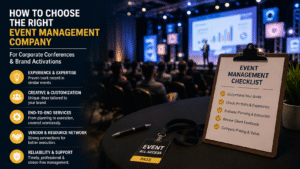
Event Management Company Selection Checklist
| Evaluation Area | What to Check |
|---|---|
| Portfolio | Similar events and relevant industry work |
| Strategy | Understands brand goal and audience |
| Creativity | Offers original concepts |
| Budget | Gives transparent cost breakdown |
| Vendors | Has reliable vendor network |
| Production | Strong technical execution |
| Digital Support | Can promote and amplify the event |
| Engagement | Plans audience interaction |
| Technology | Uses tracking and reporting tools |
| Communication | Clear updates and point of contact |
| Risk Planning | Backup and crisis handling process |
| Reporting | Post-event performance summary |
Conclusion
Choosing the right event management company is not about selecting the cheapest vendor. It is about choosing a partner who understands your brand, audience, event objective and growth goals.
For corporate conferences, the agency must bring structure, production discipline and professional execution. For brand activations, it must bring creativity, audience engagement and strong recall.
The best event partner combines planning, creativity, operations, digital promotion and measurable reporting.
Buzz Entertainment Media helps brands build stronger visibility through digital marketing, SEO, social media, website development and conversion-focused strategies. For businesses planning corporate conferences or brand activations, a digital-first approach can help turn an event into a long-term brand asset.
6. FAQ SECTION
1. How do I choose the right event management company?
Choose an event management company by reviewing its portfolio, relevant experience, creative process, budget transparency, vendor network, production capability, digital support and reporting process.
2. What should I look for in a corporate event management company?
Look for experience in corporate conferences, speaker coordination, registration systems, production quality, audience flow planning, budget control and post-event reporting.
3. How do I choose a brand activation agency?
Choose a brand activation agency that understands your product, audience, brand message and engagement goal. It should offer creative concepts, interactive ideas and digital amplification.
4. What questions should I ask an event planner?
Ask about past work, creative process, budget inclusions, vendor management, timeline, backup plans, digital promotion, audience engagement and post-event reporting.
5. What makes a good event management company?
A good event management company combines strategy, creativity, vendor control, execution discipline, clear communication, technology use and ROI-focused reporting.
6. Why should brands hire an event management company?
Brands hire event management companies to reduce execution stress, improve event quality, manage vendors, control timelines and deliver professional audience experiences.
7. Is digital marketing important for event management?
Yes. Digital marketing helps promote the event, drive registrations, increase visibility, capture leads, share live updates and extend event impact after completion.