TL;DR
AI is rapidly changing the event industry by automating repetitive tasks, personalizing attendee experiences, improving engagement, and delivering deeper insights. Businesses that embrace AI in event planning can reduce costs, improve efficiency, and create more meaningful interactions that drive measurable ROI.
Why AI Is Becoming Essential in Event Planning
The events industry has always relied on creativity, logistics, and relationship building.
Today, however, attendee expectations have changed dramatically.
Modern audiences expect:
- Personalized experiences
- Instant communication
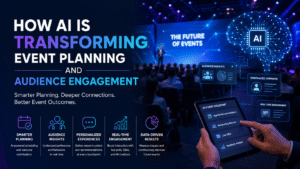
- Relevant content recommendations
- Seamless registration
- Faster support
- Interactive engagement
Meeting these expectations manually is becoming increasingly difficult.
This is where AI in Event Planning is transforming the industry.
Artificial intelligence allows event organizers to process large volumes of attendee data, automate workflows, predict attendee behavior, and deliver personalized experiences at scale.
Instead of replacing event professionals, AI enables them to focus more on strategy, creativity, and audience experiences.
The Evolution of Event Management Technology
The event industry has progressed through several phases:
| Era | Event Management Approach |
|---|---|
| Traditional Events | Manual planning and paperwork |
| Digital Events | Event software and online registration |
| Smart Events | Data-driven decision making |
| AI-Powered Events | Automation, prediction, personalization |
Organizations that adopt AI gain a competitive advantage because they can make decisions faster and create better attendee experiences.
7 Ways AI Is Transforming Event Planning
1. Automated Event Logistics
Planning a corporate event involves hundreds of operational tasks.
AI helps automate:
- Registration workflows
- Ticket management
- Scheduling
- Venue allocation
- Email communication
- Resource planning
This reduces administrative workload and minimizes human error.
2. Predictive Attendee Analytics
One of AI’s most powerful capabilities is prediction.
By analyzing historical event data, AI can forecast:
- Attendance levels
- Registration trends
- Session popularity
- Drop-off rates
- Engagement patterns
This enables planners to make smarter decisions before the event begins.
3. Personalized Event Experiences
Personalization is no longer optional.
AI analyzes attendee interests and behavior to recommend:
- Relevant sessions
- Networking opportunities
- Exhibitors
- Workshops
- Content tracks
This increases attendee satisfaction and engagement.
4. AI-Powered Networking
Networking remains one of the biggest reasons people attend events.
AI-powered platforms can match attendees based on:
- Industry
- Business goals
- Interests
- Job roles
- Purchasing intent
This creates higher-quality connections and more productive conversations.
5. Smart Event Marketing
Marketing is becoming increasingly data-driven.
AI helps event marketers:
- Optimize advertising campaigns
- Identify high-intent audiences
- Predict registration likelihood
- Personalize email campaigns
- Improve campaign performance
As a result, promotional budgets are used more efficiently.
6. Real-Time Audience Engagement
Keeping attendees engaged is one of the biggest event challenges.
AI-powered tools can deliver:
- Live polls
- Interactive Q&A
- Sentiment analysis
- Chatbots
- Personalized notifications
These features create a more dynamic event experience.
7. Post-Event Data Analysis
The event doesn’t end when attendees leave.
AI can analyze:
- Engagement metrics
- Session performance
- Lead quality
- Audience sentiment
- Conversion data
These insights help improve future events and demonstrate ROI.
AI Tools Every Event Organizer Should Know
Popular AI-powered event technologies include:
- Event registration platforms
- AI chatbots
- Networking recommendation engines
- Audience analytics tools
- Marketing automation platforms
- AI-powered event apps
- Predictive analytics software
These solutions help organizations manage events more effectively while enhancing attendee experiences.
Benefits of AI for Brands and Event Organizers
Increased Efficiency
Automation reduces repetitive work and operational costs.
Better Personalization
Attendees receive experiences tailored to their preferences.
Improved Engagement
Interactive AI features increase participation and retention.
Stronger Lead Generation
AI helps identify and prioritize high-intent prospects.
Better Decision Making
Real-time data enables faster and more accurate decisions.
Challenges and Limitations of AI in Events
Despite its advantages, AI is not perfect.
Common challenges include:
- Data privacy concerns
- Implementation costs
- Learning curve
- Dependence on quality data
- Technology integration issues
Organizations should view AI as a support tool rather than a complete replacement for human expertise.
Future Trends in AI-Powered Events
Over the next five years, AI is expected to drive:
- Hyper-personalized attendee journeys
- Advanced event analytics
- AI-generated event content
- Smart virtual assistants
- Real-time translation
- Immersive event experiences
These innovations will further blur the line between physical and digital engagement.
Why Human Creativity Still Matters
While AI can automate processes and analyze data, it cannot replace:
- Emotional intelligence
- Creative storytelling
- Relationship building
- Strategic thinking
- Brand experience design
The most successful events will combine human creativity with AI-powered efficiency.
6. FAQ SECTION
1: How is AI used in event planning?
AI is used in event planning to automate repetitive tasks, analyze attendee behavior, personalize experiences, optimize marketing campaigns, and improve decision-making.
From registration management to audience engagement and post-event analytics, AI helps event organizers save time while delivering better experiences.
2: What are the biggest benefits of AI in event planning?
The primary benefits include:
- Reduced manual workload
- Better attendee personalization
- Improved audience engagement
- Smarter event marketing
- Faster customer support
- Better lead generation
- More accurate event analytics
These advantages help organizers improve efficiency while maximizing event ROI.
3: Can AI improve audience engagement at events?
Yes.
AI can significantly improve audience engagement through personalized content recommendations, live polls, chatbots, networking suggestions, and real-time interaction tools.
These technologies make attendees feel more connected and involved throughout the event journey.
4: Will AI replace event planners?
No.
AI is designed to support event professionals rather than replace them.
While AI can automate data processing, scheduling, and communication, human expertise remains essential for creativity, relationship building, problem-solving, and experience design.
The future of event management lies in combining human creativity with AI-powered efficiency.
5: What AI tools are commonly used for events?
Popular AI-powered event tools include:
- Event management software
- AI chatbots
- Marketing automation platforms
- Predictive analytics tools
- Networking recommendation engines
- Audience sentiment analysis software
- AI-powered event apps
These tools help streamline operations and improve attendee experiences.
6: How does AI personalize event experiences?
AI analyzes attendee preferences, registration data, browsing behavior, and engagement patterns.
Based on this information, AI can recommend:
- Relevant sessions
- Networking opportunities
- Exhibitors
- Speakers
- Workshops
- Personalized agendas
This creates a more valuable experience for each attendee.
7: What is the future of AI in the events industry?
The future of AI in events includes:
- Hyper-personalized attendee journeys
- AI-generated event content
- Smart networking recommendations
- Real-time language translation
- Predictive attendance forecasting
- Virtual AI event assistants
- Enhanced hybrid event experiences
These innovations are expected to transform how events are planned, marketed, and experienced.
8: Is AI beneficial for corporate events only?
No.
AI can benefit:
- Corporate events
- Conferences
- Trade shows
- Exhibitions
- Product launches
- Brand activations
- Hybrid events
- Virtual events
Any event that involves attendee engagement and data collection can benefit from AI-powered solutions.